Reproducible Data Science with R
2025-11-24
Why does it matter?
It is the #1 skill-gap in the job market:
- Academia,
- Industry,
- Government, NGOs, etc.
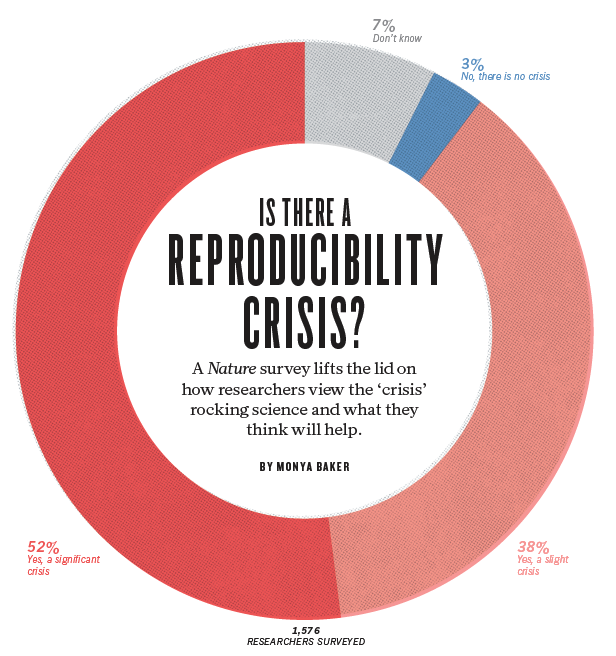
Is there a REPRODUCIBILITY CRISIS in science?
A Nature survey with ~1,600 researchers found that
+70% failure rate to reproduce another scientist’s experiments
+50% have failed to reproduce their own experiments
Main causes: selective reporting, weak stats, code/data unavailability, etc.
GOOD NEWS IS…

Brief History of R 📜
- Origin: Developed in the early 1990s by Ross Ihaka and Robert Gentleman at the University of Auckland, New Zealand.
- Inspiration: R is an implementation of the S language, designed at Bell Laboratories for data analysis.
- Open Source: Released as free, open-source software, leading to a large community of users and contributors.
- Popularity: Today, R is one of the top programming languages for statistical analysis and data science.
R vs. Excel for Data Wrangling 📊
- Excel: Known for ease of use, popular among business and finance professionals.
- Pros: Intuitive, good for small datasets and quick analysis.
- Cons: Limited in handling large datasets, lacks reproducibility.
- R: Provides powerful data manipulation packages (e.g.,
dplyr,tidyr).- Pros: Handles large datasets efficiently, supports complex transformations, fully reproducible.
- Cons: Requires programming knowledge, steeper learning curve than Excel.

Tip
- Tip: R is highly scalable and is ideal for projects requiring automation, reproducibility, and handling large datasets.
R vs. SAS for Statistical Analysis 📉
- SAS: A powerful statistical software suite used widely in industries such as healthcare and finance.
- Pros: Robust for regulatory environments, highly standardized.
- Cons: Proprietary and costly, limited community contributions.
- R: Offers a vast array of statistical packages and flexibility in method implementation.
- Pros: Free and open-source, customizable, strong community support.
- Cons: Requires more coding and configuration for regulatory standards.

Note
- Comparison: R is often chosen for research and academia due to its flexibility and customization, while SAS remains strong in industries needing strict compliance and control.
R vs Python vs Julia 🔍
- R, Python, and Julia are popular languages in data science and research.
- Each language has unique strengths, ideal use cases, and licensing considerations.



R: Strengths and Use Cases 🧮
- Designed for Statistics: R is optimized for statistical analysis, making it ideal for research and academia.
- Visualization: Excellent data visualization libraries like
ggplot2. - Licensing: Licensed under GPL; many packages are also GPL, with some using MIT or BSD.
Ideal Use Cases:
- Data analysis, visualization, and complex statistical modeling.
- Research and academia where open-source, reproducible code is needed.
- Licensing in Production: GPL may restrict proprietary use; check package licenses carefully.
Python: Strengths and Use Cases 🐍
- General-Purpose Language: Python is popular for both data science and software development.
- Machine Learning & AI: Extensive libraries for ML and AI, such as
scikit-learn,TensorFlow. - Licensing: PSFL (Python Software Foundation License), highly permissive for proprietary use.
Ideal Use Cases:
- End-to-end development, from data wrangling to ML and web development.
- Production-ready ML and AI applications.
- Licensing in Production: Permissive licenses allow closed-source use, making Python production-friendly.
Julia: Strengths and Use Cases 🚀
- High Performance: Designed for scientific computing, close to the speed of C/C++.
- Ease of Use: Combines high-level syntax with low-level performance.
- Licensing: MIT license, very permissive for commercial and open-source use.
Ideal Use Cases:
- Large-scale simulations, optimization problems, high-performance computing.
- Licensing in Production: MIT license allows proprietary use without restrictions.
THANK YOU!
acorrend@uoguelph.ca
Adrian A. Correndo
Assistant Professor
Sustainable Cropping Systems
Department of Plant Agriculture
University of Guelph
Rm 226, Crop Science Bldg | Department of Plant Agriculture
Ontario Agricultural College | University of Guelph | 50 Stone Rd E, Guelph, ON-N1G 2W1, Canada.
Contact me
 |
 |
 |
 |
 |
 |